
The challenge
It’s not hyperbole to say that the coronavirus outbreak changed the world over the course of a few weeks. Many people found themselves unable to work or otherwise with less stable or predictable income than before.
Like most brands, Credit Karma UK was keen to help users find their way through this difficult time, without adding to the ‘Letter from the CEO’ emails clogging up their inboxes.
What we did
With help from our UX research team in the US, we conducted a diary study with 40 members of the UK public. The participants were specifically chosen to make sure we had people from different ethnic backgrounds and financial positions before the outbreak.
The research was used across the business to help inform our product, but also to see which emerging financial issues we could support people with.
What I did
While the broader team started to sift through the diary entries, I took the lead on digging into them looking specifically for financial themes we were starting to see show up in the news, including a worrying increase in fraud and the offer of payment holidays from lenders.
I watched the entries with these things in mind:
- How broad or narrow are the problems people face, and are they interconnected?
- Which words are people using when they talk about these things?
- Where are they inclined to look for help?
Looking out for these things helped me to decide what format the content should take. At the time, Credit Karma only had a simple help centre for hosting content, as opposed to a blog. That limited the output to words-only, but the research helped me make some important content decisions.
Payment holidays
When I first started investigating payment holidays, I thought they would be pretty well-received by people who might need them. By listening to what prospective readers had to say, it was clear that the fact interest would still be charged during the holiday was the cause of a lot of frustration from loyal customers. It was clear that these holidays had their pitfalls, so I wanted to make that apparent to readers.
I also listened carefully to how people described these ‘holidays’. I found that people used ‘holidays’, ‘breaks’ and ‘freezes’, all to describe the same thing. I knew it would be important to make sure people could quickly recognise what the content was talking about, but I felt the term ‘holidays’ was particularly sensitive at a time when – frankly – nobody could go on one. And not paying your mortgage because you can’t isn’t a particularly ‘holiday’ mindset.
I also thought that payment ‘holidays’ were pretty much the only thing on offer. A take-it-or-leave-it affair. This turned out to not be the case, as several diary entries reported getting help that was more tailored to the individual’s needs. Some desk research revealed that lenders were obliged to offer holidays or something equivalent that better suited the borrower’s needs.
So I set the content up to be much broader than I’d initially imagined it would be, focusing on finding out what help might be on offer, rather than payment holidays specifically.
“What help can I get from my lenders during the coronavirus outbreak?”
I also chose to call payment ‘holidays’ payment ‘breaks’ instead. It felt much more neutral and functional, which I felt would help put the reader in the right frame of mind. But given what I’d heard in the diary entries, I wanted to make sure they were recognisable to people who had only ever seen them as ‘holidays’ or ‘freezes’.
“Usually, a lender will offer you a payment break – sometimes called a payment holiday or payment freeze.”
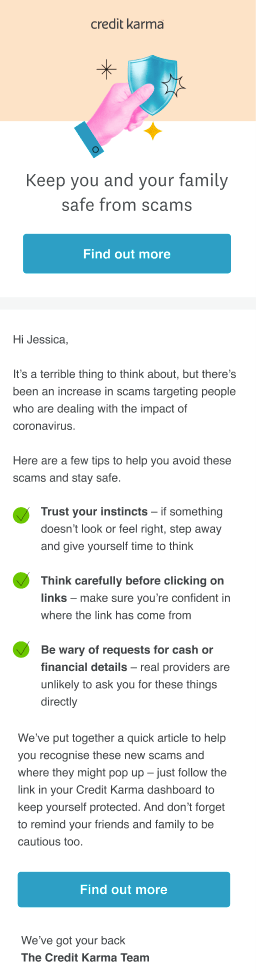
We shared the article with an email to all users. Credit Karma is looking to build trust with people in the UK as a relatively new brand and emails like this help balance out revenue emails we send for the financial products available in our marketplace.
Subject: Get the right help from your lenders
Pre-header: Find out how to go about getting the right help from your lenders |
Scams and fraud
I followed the same process when researching coronavirus scams and had my assumptions challenged once again.
News reports had been focusing quite heavily on online scams, including email and social media. But I quickly heard from the diary entries that fraud had been cropping up all over the place, especially by phone and knocks at the front door.
Something as innocent as an offer to do someone’s shopping needed to be treated with suspicion if it came from a stranger. So I broadened the scope to include a quick list of the places where the scams could appear.
Our quantitative research showed that 8% of Brits had been the victim of a scam and 16% had been targeted by one. Meanwhile, more than a third had seen an increase in scams overall. I used this to segment people into 3 groups to serve with the content.
- People who weren’t aware or had seen a general increase looking to be more aware
- People who had been targeted looking for help
- People who had been the victim of a scam looking for help
So I set the content up to reflect this, with internal links to help people self-select according to the help or information they need most.
Subject: Stay safe from coronavirus scams
Pre-header: Tips to spot scams and avoid them |
The outcome
It’s difficult to know the exact outcome of this work, but I hope that some of our users found it helpful and easy to digest with a lot of information swirling around during an already stressful time.
While being useful to users, it also has the effect of positioning Credit Karma as a brand that’s here to help, which should promote trust in the brand overall.
 Patrick Adam Ross