
When I started at Credit Karma, the company was in hyper-growth mode. It had bought a smaller UK-based company called Noddle earlier in the year, and had re-skinned Noddle’s product to set the Credit Karma brand up in the UK.
The initial focus was very much on launching an MVP built with Credit Karma technology to the UK market as quickly as possible. Much of the MVP work was underway, with the copy had been written by a US-based UX writer. When I joined the business, I took over as the only writer working on Credit Karma UK, based in product but lending a hand with marketing and customer support too.
The challenge
With no clear voice, tone and style guidelines in place, it was difficult to make wording choices other than using the basic principles of UX writing. This made it onerous to come to an agreement on wording with other designers and product managers.
Outside of the product, the questions were flying in. Email. Slack. Tags on Google Docs.
“What do you think of this wording?”
“Is that how we would sound?”
“What would we call this part of the product?“
It felt like I’d been elected the new staff writer for the organisation, with the responsibility of signing off every word. It wasn’t sustainable and it wasn’t helping Credit Karma achieve it’s goal of establishing itself as a trusted brand in the UK.
What I did
My first move was to work on a voice chart and iterate on it with designers and product managers. My first priority was always going to be the product, and it felt like that should be the nucleus of Credit Karma’s voice, tone and style anyway.
With no time or budget to seek external help or work on an in-depth project to establish our voice, I put a voice chart together based on the following:
- The first set of user research done in the UK
- The first set of market-fit research done in the UK
- My experience over my first few months
- My conversations with designers, PMs, and leadership
- The regulatory rules and environment in the UK
- The overall company vision, and vision for UK specifically
- The voice, tone and style in the US
- The guidelines that came out of a recent rebrand in the US
We settled on three voice principles, geared towards setting a basic standard we could build on as the product and brand found it’s feet in the UK.
Next, I set about working on what I called an ‘MVP’ (Minimum Viable Product) voice, tone and style guide for everyone at Credit Karma to use when writing for the brand. I set this up to be easily navigable and shared with the whole organisation, giving people the opportunity to self-serve for the first time.
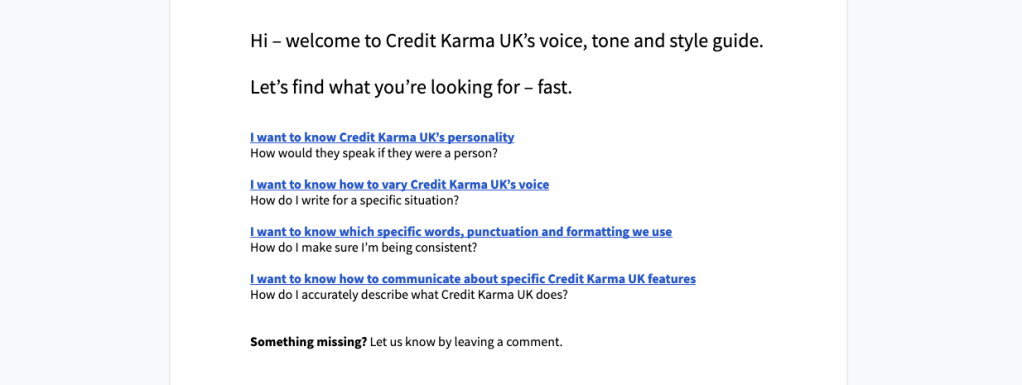
Of course, this was only the beginning. I then set about embedding the guide into the processes of different teams. I went on a ‘roadshow’, presenting to the relevant teams and sharing the link to the doc so everyone had access and could start using it. I also took the opportunity to explain more about myself and the role of content design, to support awareness of the value of the function with the wider business.
The outcome
The guide definitely gave us what we needed at the time, encouraging people to self-serve and providing a basis for our brand.
However, while the voice, tone and style guide is still in use today, it ultimately began to gather dust. If I was still with Credit Karma, I would be looking to install a more formal voice, tone and style guide as part of a content design system, giving us a more coherent and connected user journey.
 Patrick Adam Ross